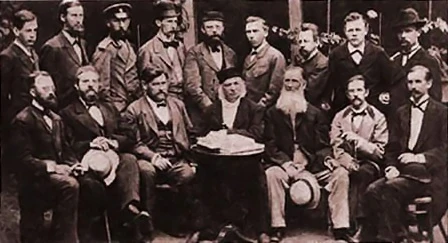
Henry Norris Russell
American astronomer who co-created the Hertzsprung–Russell diagram.

via Wikipedia: Henry Norris Russell · see source
Henry Norris Russell (October 25, 1877 – February 18, 1957) was an American astronomer who, along with Ejnar Hertzsprung, developed the Hertzsprung–Russell diagram (1910). In 1923, working with Frederick Saunders, he developed Russell–Saunders coupling, also known as LS coupling. Born in Oyster Bay, New York, Russell studied at Princeton University under Charles Augustus Young, earning his B.A. in 1897 and his doctorate in 1900. He spent his career at Princeton, serving as director of the Princeton University Observatory from 1912 to 1947, and co-wrote a standard astronomy textbook that popularized the Vogt–Russell theorem.
- born
- October 25, 1877, Oyster Bay, New York
- died
- February 18, 1957, Princeton, New Jersey
- field
- Astronomy
- nationality
- American
- known_for
- Hertzsprung–Russell diagram, Russell–Saunders coupling (LS coupling)
Verified Timeline
Lore & Background
Russell was born on 25 October 1877 at Oyster Bay, New York, the son of Rev Alexander Gatherer Russell (1845-1911) and his wife, Eliza Hoxie Norris. After graduating from Princeton Preparatory School in 1893, he studied astronomy at Princeton University, obtaining his B.A. in 1897 and his doctorate in 1900, studying under Charles Augustus Young. From 1903 to 1905, he worked at the Cambridge Observatory with Arthur Robert Hinks as a research assistant of the Carnegie Institution and came under the strong influence of George Darwin. He returned to Princeton to become an instructor in astronomy (1905–1908), assistant professor (1908–1911), professor (1911–1927) and research professor (1927–1947). He was also the director of the Princeton University Observatory from 1912 to 1947 where Charlotte Moore Sitterly helped him measure and calculate the properties of stars. He died in Princeton, New Jersey on 18 February 1957 at the age of 79 and is buried in Princeton Cemetery. In November 1908 Russell married Lucy May Cole (1881-1968). They had four children. Their youngest daughter, Margaret Russell (1914-1999), married the astronomer Frank K. Edmondson in the 1930s. Russell co-wrote an influential two-volume textbook in 1927 with Raymond Smith Dugan and John Quincy Stewart: Astronomy: A Revision of Young’s Manual of Astronomy (Ginn & Co., Boston, 1926–27, 1938, 1945). This became the standard astronomy textbook for about two decades. The textbook popularized the idea that a star's properties (radius, surface temperature, luminosity, etc.) were largely determined by the star's mass and chemical composition, which became known as the Vogt–Russell theorem (including Heinrich Vogt who independently discovered the result). Russell dissuaded Cecilia Payne-Gaposchkin from concluding that the composition of the Sun is different from that of the Earth in her thesis, as it contradicted the accepted wisdom at the time. He realized she was correct four years later after deriving the same result by different means. In his paper Russell credited Payne with discovering that the Sun had a different chemical composition from Earth but never shared the rewards of the fame he readily accepted for her work which he’d failed to recognize until years later.
Reader's Guide
Henry Norris Russell's significance lies in two foundational contributions to astrophysics. The Hertzsprung–Russell diagram, developed with Ejnar Hertzsprung in 1910, remains the central tool for understanding stellar evolution and classification. His work with Frederick Saunders on Russell–Saunders coupling (LS coupling) in 1923 provided a key framework for interpreting atomic spectra in stars. Russell's textbook, co-authored with Dugan and Stewart, shaped astronomical education for about two decades and advanced the Vogt–Russell theorem linking stellar properties to mass and composition. His career at Princeton spanned over four decades, during which he directed the observatory and mentored researchers like Charlotte Moore Sitterly. However, his treatment of Cecilia Payne-Gaposchkin's discovery of the Sun's composition—initially dissuading her from concluding it, then later realizing she was correct and crediting her in his paper, but never sharing the rewards of the fame he accepted for her work—remains a noted episode in the history of science. Russell received numerous honors, including the Gold Medal of the Royal Astronomical Society (1921), the Henry Draper Medal (1922), the Bruce Medal (1925), and the Rumford Prize (1925), and was elected a Foreign Member of the Royal Society (1937).
Did You Know?
- Russell developed the Hertzsprung–Russell diagram along with Ejnar Hertzsprung in 1910.
- In 1923, working with Frederick Saunders, he developed Russell–Saunders coupling, also known as LS coupling.
- Russell dissuaded Cecilia Payne-Gaposchkin from concluding that the Sun's composition differs from Earth's in her thesis, but later realized she was correct and credited her in his paper.
- He co-wrote the standard astronomy textbook Astronomy: A Revision of Young’s Manual of Astronomy, which was published in two volumes from 1926–27 and remained influential for about two decades.
- Russell was director of the Princeton University Observatory from 1912 to 1947, where Charlotte Moore Sitterly helped him measure and calculate the properties of stars.
Frequently Asked Questions
Who is Henry Norris Russell?
He was an American astronomer born in Oyster Bay, New York, in 1877, best remembered for co-developing the Hertzsprung–Russell diagram with Ejnar Hertzsprung around 1910. He spent the later part of his career at Princeton, where he died in 1957.
What is the Hertzsprung–Russell diagram and why does it matter?
It is a scatter plot of a star's luminosity versus its temperature (or spectral class) that reveals natural groupings such as the main sequence, giants, and white dwarfs. Russell and Hertzsprung independently arrived at the idea around 1910, and the diagram has remained a foundational tool for understanding stellar structure and evolution ever since.
What is Russell–Saunders coupling (LS coupling)?
It is a scheme for combining individual electron spins and orbital angular momenta to describe the total angular momentum of an atom. Russell and Frederick Saunders formalized the method in 1923, and it still serves as the standard framework for interpreting atomic spectra.
Where was Henry Norris Russell born and where did he die?
He was born in Oyster Bay, New York, on October 25, 1877, and passed away in Princeton, New Jersey, on February 18, 1957.
Why is Henry Norris Russell considered important in the history of astronomy?
His H-R diagram gave the field a visual language for classifying stars and tracing their life cycles, while his LS coupling work supplied the notation for reading atomic energy levels. Together those two contributions shaped how astronomers interpret both the stars themselves and the atoms that compose them.
More in Astronomers And Astrophysicists 1-24
Elsewhere in the Astronomers And Astrophysicists universe
Spotted an error? Know more?
This is a living reference — every entry is fact-audited, and reader corrections feed straight into our audit queue. Suggest an edit · See this site's audit record