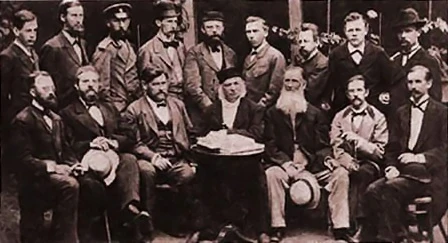
William Herschel
Baltic German astronomer and geodesist known for studying double stars and initiating the Struve Geodetic Arc.

Friedrich Georg Wilhelm von Struve (Russian: Василий Яковлевич Струве, romanized: Vasily Yakovlevich Struve; 15 April 1793 – 23 November [O.S. 11 November] 1864) was a Baltic German astronomer and geodesist. He is best known for studying double stars and initiating a triangulation survey later named Struve Geodetic Arc in his honor.
- born
- 15 April 1793
- died
- 23 November [O.S. 11 November] 1864
- field
- Astronomy, geodesy
- nationality
- Baltic German
- known_for
- Studying double stars, initiating the Struve Geodetic Arc
Verified Timeline
Lore & Background
Struve was born to the aristocratic Struve family at Altona, Duchy of Holstein (then a part of the Denmark–Norway kingdoms), the son of Jacob Struve (1755–1841). To avoid military service during the French occupation of Holstein, his family moved to the Russian Empire, equipped with Danish passports. In 1808 he entered the Imperial University of Dorpat, where he first studied philology, but soon turned his attention to astronomy. From 1813 to 1820, he taught at the university and collected data at the Dorpat Observatory, and in 1820 became a full professor and director of the observatory. His teachings had an effect still felt at the university. Struve was occupied with research on double stars and geodesy in Dorpat until 1839, when he founded and became director of the new Pulkovo Observatory near St Petersburg. Among other honors, he won the Gold Medal of the Royal Astronomical Society in 1826. He was elected a Fellow of the Royal Society in March 1827 and was awarded their Royal Medal the same year. Struve was elected a member of the Royal Swedish Academy of Sciences in 1833, and a Foreign Honorary Member of the American Academy of Arts and Sciences in 1834. In 1843 he formally adopted Russian nationality. He retired in 1862 due to failing health. The asteroid 768 Struveana was named jointly in his honour and that of Otto Wilhelm and Karl Hermann Struve, and a lunar crater was named for another three astronomers of the Struve family: Friedrich Georg Wilhelm, Otto Wilhelm and Otto. In 1969 the Friedrich Georg Wilhelm Struve Monument was established on Toome Hill, Tartu.
Reader's Guide
Struve's name is best known for his observations of double stars, which he carried on for many years. Although double stars had been studied earlier by William Herschel, John Herschel and Sir James South, Struve outdid any previous efforts. While at Dorpat, he obtained in 1824 a refracting telescope with an aperture of 23 cm (about 9 inches) made by Joseph von Fraunhofer, said to be a masterpiece of optical and mechanical quality. With this telescope, Struve discovered a very large number of double stars. In 1827, he published his double star catalogue Catalogus novus stellarum duplicium. Stars of his catalogue are sometimes indicated by the Greek letter sigma, Σ. Thus, 61 Cygni is also designated as Σ2758. Since most double stars are true binary stars rather than mere optical doubles (as William Herschel had been the first to discover), they orbit around their common barycenter, and slowly change position over the years. Thus, Struve made micrometric measurements of 2714 double stars from 1824 to 1837, and published these in his work Stellarum duplicium et multiplicium mensurae micrometricae. Struve carefully measured the 'constant of aberration' in 1843. He was also the first to measure the parallax of the star Vega, though Friedrich Bessel had been the first to measure the parallax of a star (61 Cygni). In an 1847 work, Etudes d'Astronomie Stellaire: Sur la voie lactee et sur la distance des etoiles fixes, Struve was one of the first astronomers to identify the effects of interstellar extinction (though he provided no mechanism to explain the effect). His estimate of the average rate of visual extinction, 1 mag per kpc, is remarkably close to modern estimates (0.7–1.0 mag per kpc). He was also interested in geodetic surveying, and in 1831 published Beschreibung der Breitengradmessung in den Ostseeprovinzen Russlands. He initiated the Struve Geodetic Arc, a chain of survey triangulations stretching from Hammerfest in Norway to the Black Sea, through ten countries and over 2,820 km, to establish the exact size and shape of the earth. UNESCO listed the chain on its List of World Heritage Sites in Europe in 2005. In 1853, he was elected as a member of the American Philosophical Society.
Did You Know?
- Struve's family moved to the Russian Empire with Danish passports to avoid military service during the French occupation of Holstein.
- He obtained a refracting telescope with an aperture of 23 cm (about 9 inches) made by Joseph von Fraunhofer in 1824, said to be a masterpiece of optical and mechanical quality.
- Struve made micrometric measurements of 2714 double stars from 1824 to 1837.
- He was the first to measure the parallax of the star Vega.
- The Struve Geodetic Arc stretches over 2,820 km through ten countries and was listed by UNESCO as a World Heritage Site in 2005.
Frequently Asked Questions
Who is William Herschel?
Frederick William Herschel (1738–1822) was a German-born British astronomer and musician who became one of the most prolific sky observers of the 18th century. He is celebrated for expanding the known solar system and for mapping thousands of nebulae and double stars.
What is William Herschel most famous for?
He is best known for spotting Uranus in 1781, the first new planet identified since ancient times. That single observation effectively doubled the apparent size of the solar system in one night.
What did Herschel discover about light and heat?
Using a simple glass prism and a row of thermometers, he showed that invisible heat-carrying radiation exists just beyond the red end of the visible spectrum. This became the first detection of infrared radiation, and it did not depend on spectrophotometric methods that would not be developed for decades.
What was Herschel's background before he became an astronomer?
Born in the Electorate of Hanover in 1738, he first made a living as an organist and composer before relocating to England, where he turned to building large telescopes and conducting systematic sky surveys. His dual identity as musician and scientist made him a somewhat unusual figure in 18th-century science.
Why is William Herschel important to the history of astronomy?
Beyond Uranus and infrared light, he compiled extensive catalogues of nebulae, star clusters, and double stars that served as foundational references for generations of observers. His work helped shift astronomy from a modest cataloguing exercise into a quantitative science of the heavens.
More in Astronomers And Astrophysicists 25-27
Elsewhere in the Astronomers And Astrophysicists universe
Spotted an error? Know more?
This is a living reference — every entry is fact-audited, and reader corrections feed straight into our audit queue. Suggest an edit · See this site's audit record