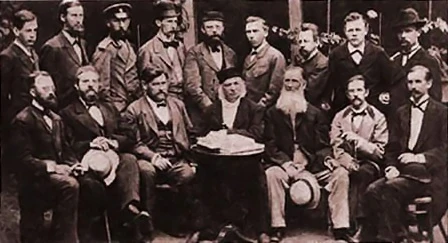
Ejnar Hertzsprung
Danish chemist and astronomer who co-developed the Hertzsprung–Russell diagram.

via Wikipedia: Astronomical object · see source
Ejnar Hertzsprung was a Danish chemist and astronomer, best remembered for his role in developing the Hertzsprung–Russell diagram, a fundamental tool for classifying stars by spectral type, stage of development, and luminosity. He also made contributions to the study of Cepheid variable stars and discovered one asteroid.
- field
- Chemistry and astronomy
- known_for
- Hertzsprung–Russell diagram
Lore & Background
Hertzsprung was born in Frederiksberg, Denmark, the son of Severin and Henriette.
Reader's Guide
Ejnar Hertzsprung's significance lies primarily in his development of the Hertzsprung–Russell diagram, a classification system that divides stars by spectral type, stage in their development, and luminosity. His calibration of the Cepheid period-luminosity relationship, despite an error, advanced the measurement of cosmic distances. The diagram remains a cornerstone of astrophysics, linking observational data to theoretical models of stellar life cycles.
Did You Know?
- In 1913, Hertzsprung determined distances to several Cepheid variable stars by parallax, calibrating the period-luminosity relationship discovered by Henrietta Leavitt.
- Hertzsprung made a mistake in his Cepheid calibration that put the stars 10 times too far.
The Diagram That Changed Stellar Astronomy
In 1913, Ejnar Hertzsprung, working alongside but independently of Henry Norris Russell, produced what would become one of the most consequential tools in stellar science: a diagram that organized stars by their luminosity and their color. Before this visualization, astronomers had accumulated vast amounts of data about individual stars, but lacked a single framework that revealed the underlying patterns connecting them. The H-R diagram gave the field exactly that. By placing each star at a coordinate defined by how brightly it shone and what hue it emitted, Hertzsprung and Russell made visible a structure that had been hiding in plain sight within the numbers. The result was immediate and striking: the overwhelming majority of stars clustered along a single diagonal band, later named the main sequence. This simple act of plotting turned a chaotic scatter of stellar properties into an orderly landscape, giving future generations of astronomers a map they could navigate to understand where any given star sat in its life cycle.
Independent Paths to the Same Insight
What makes the 1913 achievement of Ejnar Hertzsprung and Henry Norris Russell particularly remarkable is that neither scientist was building on the other's work. They arrived at the same conceptual leap—organizing stars by luminosity and color—entirely on their own. This parallel discovery underscores how the question was ripe in the astronomical community at the time. The late nineteenth and early twentieth centuries had produced an explosion of observational capability: larger telescopes, photographic plates that could capture images of the Moon and other bodies, spectroscopy pioneered by figures like Fraunhofer and Secchi, and the photoelectric photometer that let researchers measure a star's color and brightness with precision. These tools generated enormous datasets about stellar properties, and the natural next step was to find a way to see the whole picture at once. Hertzsprung's independent contribution placed him squarely at the center of that transition from isolated measurements to unified understanding.
A Foundation for Classification
The Hertzsprung–Russell diagram did not merely organize existing knowledge; it became the scaffolding upon which future stellar taxonomy was built. The most immediate revelation was the main sequence: the dense diagonal band along which most stars aligned, suggesting a common evolutionary pathway governed by factors such as mass, composition, and stage of development. This insight gave astronomers a shared vocabulary and a reference frame for discussing stellar life cycles. The diagram's influence extended well beyond 1913. In 1943, William Wilson Morgan and Philip Childs Keenan published a refined system of stellar classification that was explicitly grounded in the H-R framework. Their work demonstrated that the original plot was not just a convenient chart but a genuine structural principle of stellar physics. For Hertzsprung, whose name is permanently bound to that 1913 diagram, the legacy is one of providing the field with its most fundamental organizing principle—a tool that every subsequent generation of astronomers would return to.
The Broader Canvas of Celestial Objects
To appreciate Hertzsprung's contribution, it helps to situate it within the vast hierarchy of astronomical objects that the field studies. The universe assembles itself in layers: stars form from gaseous matter pulled together by gravity, often in clusters born from condensing nebulae. These stars, in turn, populate galaxies—disk-shaped, elliptical, or irregular structures that may harbor supermassive black holes at their cores. Galaxies cluster into groups, superclusters, and filaments spanning the observable universe. Within this immense architecture, individual stars are the fundamental building blocks, and their properties—determined almost entirely by mass, composition, and evolutionary state—are what Hertzsprung sought to organize. His diagram was, in essence, a way to make sense of the smallest visible units in a cosmic structure that stretches from a single star to the largest supercluster. By focusing on luminosity and color, he gave astronomers a lens through which to read the story written in every star's light.
Frequently Asked Questions
Who is Ejnar Hertzsprung?
Ejnar Hertzsprung was a Danish scientist who worked in both chemistry and astronomy, best known for his foundational role in stellar classification. He is most widely recognized as one of the two astronomers behind the famous Hertzsprung–Russell diagram.
What is the Hertzsprung–Russell diagram and who created it?
The Hertzsprung–Russell diagram is a plot that organizes stars by spectral type, evolutionary stage, and brightness, making it a cornerstone of modern astrophysics. It was developed independently by Ejnar Hertzsprung and Henry Norris Russell in the early 20th century, with Hertzsprung's observations of nearby stars providing a key part of the framework.
What other contributions did Ejnar Hertzsprung make to astronomy?
Beyond the H-R diagram, Hertzsprung studied Cepheid variable stars, helping to establish their use as distance indicators. He also discovered one asteroid during his observational work.
When was Ejnar Hertzsprung born and when did he die?
Hertzsprung was born on 8 October 1873 in Denmark and lived until 21 October 1967, giving him a remarkably long life spanning most of the 20th century.
Why is Ejnar Hertzsprung important to astronomy?
His work on classifying stars by luminosity and temperature laid the groundwork for understanding stellar evolution, which remains central to how astronomers interpret the life cycles of stars today. The diagram that bears his name is still taught in introductory astronomy courses worldwide.
More in Astronomers And Astrophysicists 1-24
Elsewhere in the Astronomers And Astrophysicists universe
Spotted an error? Know more?
This is a living reference — every entry is fact-audited, and reader corrections feed straight into our audit queue. Suggest an edit · See this site's audit record