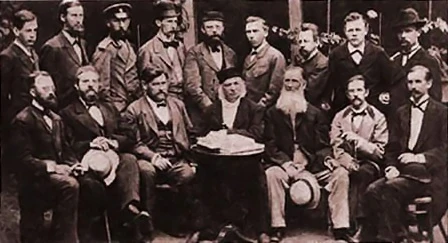
Henrietta Swan Leavitt
Discovered the period-luminosity relation for Cepheid variable stars.

via Wikipedia: List of women astronomers · see source
Her discovery of how to effectively measure vast astronomical distances led to a shift in the understanding of the scale and nature of the universe.
- field
- Astronomy
- nationality
- American
- known_for
- Discovery of the period-luminosity relationship for Cepheid variables (Leavitt's Law)
Lore & Background
Henrietta Swan Leavitt was born in Lancaster, Massachusetts, the daughter of a Congregational church minister. Leavitt suffered from progressive hearing loss and gradually became deaf. She determined that a straight line could be drawn showing a simple relation between the brightness of the Cepheid variables and their periods. Leavitt also developed the Harvard Standard for photographic measurements, a logarithmic scale ordering stars by brightness.
Reader's Guide
Leavitt's discovery of the period-luminosity relationship for Cepheids, now known as Leavitt's Law, provided astronomers with the first standard candle to measure distances to other galaxies. Before her work, only stellar parallax could measure distances, limited to several hundred light years. Hubble later used Leavitt's Law together with galactic redshifts to establish that the universe is expanding. Leavitt's discovery of an accurate way to measure distances on an intergalactic scale paved the way for modern astronomy's understanding of the cosmos.
Did You Know?
- She discovered T Pyxidis, a recurrent nova in the constellation Pyxis.
- Leavitt was paid $0.30 an hour for her work at the Harvard College Observatory.
- She was a descendant of Deacon John Leavitt, an English Puritan tailor who settled in the Massachusetts Bay Colony.
Frequently Asked Questions
What is Henrietta Swan Leavitt's most famous discovery?
She identified the period-luminosity relationship in Cepheid variable stars—now called Leavitt's Law—which revealed that a Cepheid's pulsation period directly correlates with its intrinsic brightness. This relationship became the essential tool for measuring enormous distances across the cosmos.
Why is Henrietta Swan Leavitt important?
Her method for gauging astronomical distances fundamentally reshaped humanity's understanding of the universe's scale and structure. Without her work, later breakthroughs such as determining the true size of the Milky Way and confirming cosmic expansion would have been far more difficult to achieve.
What field did Henrietta Swan Leavitt work in?
She was an astronomer specializing in the study of variable stars, particularly Cepheids, at the Harvard College Observatory. Her research sat at the intersection of observational astronomy and the emerging discipline of astrophysics.
More in Astronomers And Astrophysicists 1-24
Elsewhere in the Astronomers And Astrophysicists universe
Spotted an error? Know more?
This is a living reference — every entry is fact-audited, and reader corrections feed straight into our audit queue. Suggest an edit · See this site's audit record