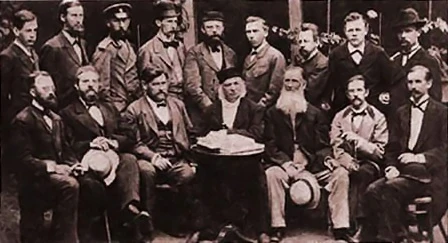
Edward Charles Pickering
American astronomer who discovered the first spectroscopic binary stars and advanced stellar photography.

via Wikipedia: Edward Charles Pickering · see source
Edward Charles Pickering (July 19, 1846 – February 3, 1919) was an American astronomer and physicist and the older brother of William Henry Pickering. Along with Carl Vogel, Pickering discovered the first spectroscopic binary stars. He wrote *Elements of Physical Manipulations* (2 vol., 1873–76). He served as director of Harvard College Observatory from 1877 until his death in 1919, where he made great leaps forward in the gathering of stellar spectra through the use of photography. He recruited over 80 women assistants, known as the Harvard Computers, who made important discoveries including Henrietta Swan Leavitt's period-luminosity relationship for Cepheids.
- known_for
- Discovery of first spectroscopic binary stars; oversight of stellar classificati
Verified Timeline
Lore & Background
Pickering was born at 43 Bowdoin Street in Boston, Massachusetts, on July 19, 1846, to a distinguished family including his brother William Henry Pickering. He was educated at Boston Latin School and the Lawrence Scientific School at Harvard, receiving a BS in 1865. He became an instructor of mathematics at Harvard, then assistant professor of physics at MIT, and in 1868 was made Thayer Professor of Physics. At MIT he created the first physics lab in America designed for students to publish their own findings. He resigned in 1877 and became director of Harvard College Observatory, serving until his death in 1919. In 1882, Pickering developed a method to photograph the spectra of multiple stars simultaneously by placing a large prism in front of the photographic plate. Using this method, his team captured images of over 220,000 stars. Under his direction, the Harvard Computers—including Williamina Fleming and Annie Jump Cannon—developed a stellar classification system based on an alphabetic system for spectral classes, known as the Harvard Stellar Classification, which became the basis for the Henry Draper Catalog. In 1896, he published observations of previously unknown lines in the spectrum of ζ-Puppis, later known as the Pickering series, which were ultimately attributed to ionized helium.
Reader's Guide
Pickering's significance lies in his transformation of Harvard College Observatory into a world-renowned institution through the systematic use of photography in astronomy. His method of photographing multiple stellar spectra simultaneously produced a catalog of over 220,000 stars and a collection of photographic plates weighing over 120 tons at his death. The stellar classification system he helped develop became the foundation for the Henry Draper Catalog. His recruitment of over 80 women—the Harvard Computers—enabled major discoveries, including Henrietta Swan Leavitt's period-luminosity relationship for Cepheids. Although the women were underpaid and often not credited, Pickering's willingness to include them in astronomy paved the way for future female scientists. The Pickering series of spectral lines, initially attributed to hydrogen, was later shown by Niels Bohr to arise from ionized helium, providing important confirmation for Bohr's atomic theory.
Did You Know?
- Pickering constructed his own telescope by the age of 12.
- He was co-founder and first president of the Appalachian Mountain Club.
- During World War I, he devised the Pickering Polaris Attachment, a device used to determine the range of guns.
- At the time of his death, the total weight of the photographic plates produced by his research exceeded 120 tons.
- Pickering was the youngest person elected to the National Academy of Sciences in 1873, at age 26.
Pioneering Physics Education at MIT
Edward Charles Pickering's early career at the Massachusetts Institute of Technology represents a foundational moment in American scientific education. After earning his B.S. from Harvard's Lawrence Scientific School in 1865, he briefly served as a mathematics instructor at Harvard before moving to MIT the following year as an assistant professor of physics. By 1868, he had been elevated to the Thayer Professorship, taking over from William Barton Rogers. During his decade at MIT, Pickering established what is described as the first physics laboratory in America specifically designed for students to generate and publish their own original research findings. He named this facility the Rogers Laboratory of Physics and assumed the title of its Director. His approach broke from the passive, lecture-driven model of the era, instead cultivating an environment where hands-on experimentation and independent inquiry were central to the student experience. He held this position until 1877, when he resigned and was succeeded by Charles R. Cross, marking the end of a period that helped shape how American universities would approach experimental physics instruction for generations to come.
The Harvard Computers and a Revolution in Stellar Classification
When Pickering took the helm of the Harvard College Observatory in 1877, the institution faced an enormous practical challenge: the sheer volume of photographic data being generated was outpacing the capacity of any single researcher to process it. His solution was to recruit a large corps of assistants, and in doing so, he opened the doors of serious astronomical work to a group that had been largely excluded from such roles. Over his tenure, Pickering brought in more than eighty women, many of them college-educated, who initially volunteered their time before earning paid positions. Among the most notable were Annie Jump Cannon, Henrietta Swan Leavitt, Antonia Maury, and Florence Cushman. Together, Pickering and these women developed a stellar classification system built on an alphabetic scheme of spectral classes, originally called the Harvard Stellar Classification. This framework ultimately became the foundation for the Henry Draper Catalog, a reference work that reorganized humanity's understanding of stellar diversity and remains a cornerstone of astronomical taxonomy.
The Pickering Series and Its Role in Atomic Theory
In 1896, Pickering published observations of previously unknown spectral lines in the star ζ-Puppis. He attributed these lines to hydrogen in 1897, and they became widely known as the Pickering series. For nearly two decades, the scientific community accepted this hydrogen attribution. Then in 1912, Alfred Fowler observed similar lines in a hydrogen-helium mixture and made the same hydrogen identification. The breakthrough came through Niels Bohr, whose theoretical analysis in his celebrated trilogy on atomic structure argued that the lines actually arose from singly ionized helium, He+, rather than hydrogen. Fowler, initially skeptical, was ultimately persuaded by Bohr's reasoning, and by 1915 the spectroscopic community had definitively reassigned the Pickering series from hydrogen to helium. The episode proved far more consequential than a simple reattribution. Bohr's work on these lines demonstrated that classical theories required fundamental re-examination and provided crucial confirmation for his emerging model of atomic structure.
A Life Beyond the Observatory
Edward Charles Pickering's world extended well beyond the telescope. Born on July 19, 1846, at 43 Bowdoin Street in Boston, he grew up in a cultured household alongside his younger brother William Henry, who would go on to become an MIT professor of physics and astronomy. As a boy, Edward was captivated by the night sky and by the age of twelve had built his own telescope. His adult interests were equally varied: he was a co-founder and first president of the Appalachian Mountain Club, an avid bicyclist and mountain climber in his younger years, and a devoted spectator of football games in his later life. He was also a passionate lover of classical music. During the First World War, he turned his ingenuity toward the war effort, devising the Pickering Polaris Attachment, a device for determining gun range. In 1874 he married Lizzie Wadsworth Sparks, whose father had previously served as President of Harvard. She remained his companion until her death in 1906; Edward died in 1919, leaving behind a life that wove together rigorous science, outdoor adventure, and deep personal devotion.
Frequently Asked Questions
Who is Edward Charles Pickering?
Edward Charles Pickering was an American astronomer and physicist (1846–1919) who spent the bulk of his professional life at Harvard. He is best known for advancing stellar spectroscopy through photography and for discovering the first spectroscopic binary stars in 1889.
What did Pickering discover about binary stars?
In 1889 he identified the first spectroscopic binary stars—pairs of stars orbiting one another that can only be revealed by periodic shifts in their spectral lines. This finding proved that many apparently single stars were actually two-star systems.
What was Pickering's role at Harvard College Observatory?
He served as director of the Harvard College Observatory from 1877 until his death in 1919. In that capacity he championed the use of photographic plates to capture and catalog stellar spectra on a large scale.
Who were the Harvard Computers?
The Harvard Computers were a group of women assistants who, under Pickering's supervision, carried out the tedious but critical work of classifying and analyzing thousands of stellar spectra. Their collective labor helped build the foundational catalogs of stellar classification.
Why is Pickering considered important in astronomy history?
His push toward photographic spectroscopy and systematic data collection reshaped how the stellar universe was studied in the late nineteenth and early twentieth centuries. By recruiting and directing the Harvard Computers, he also became a pivotal figure in the early recognition of women's contributions to scientific research.
More in Astronomers And Astrophysicists 1-24
Elsewhere in the Astronomers And Astrophysicists universe
Spotted an error? Know more?
This is a living reference — every entry is fact-audited, and reader corrections feed straight into our audit queue. Suggest an edit · See this site's audit record