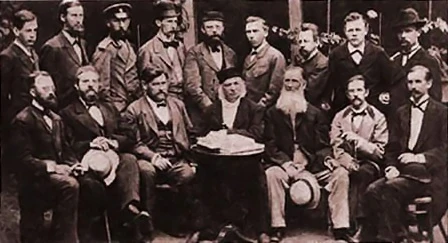
Georges Lemaître
Belgian priest and physicist who first proposed the Big Bang theory.

via Wikipedia: Georges Lemaître · see source
Georges Henri Joseph Édouard Lemaître was a Belgian Catholic priest, theoretical physicist, and mathematician who made major contributions to cosmology and astrophysics. He was the first to argue that the recession of galaxies is evidence of an expanding universe and to connect the observational Hubble–Lemaître law with the solution to the Einstein field equations in the general theory of relativity for a homogenous and isotropic universe. That work led Lemaître to propose what he called the "hypothesis of the primeval atom," now regarded as the first formulation of the Big Bang theory of the origin of the universe.
- born
- 17 July 1894
- died
- 20 June 1966
- field
- Cosmology, astrophysics, theoretical physics, mathematics
- nationality
- Belgian
- known_for
- Proposing the Big Bang theory (hypothesis of the primeval atom), Hubble–Lemaître
Verified Timeline
Lore & Background
Lemaître was born in Charleroi, Belgium, the eldest of four children of Joseph Lemaître, a prosperous industrialist who owned a glassworks factory, and Marguerite née Lannoy. He studied engineering at the Catholic University of Louvain beginning in 1911, but interrupted his studies in 1914 to volunteer for the Belgian army during World War I. He participated in the Battle of the Yser, where the Belgians halted the German advance. Transferred to artillery, he was sent to complete a course on ballistics, but his prospects for promotion to officer rank were dashed after he pointed out a mathematical error in the official artillery manual, an act marked as insubordination. At the end of hostilities, he received the Belgian War Cross with bronze palm from King Albert I, one of only five rank-and-file troops to receive that award. After the war, he abandoned engineering for the study of physics and mathematics, obtaining his doctorate in science in 1920. He was ordained as a priest on 22 September 1923 by Cardinal Mercier. With Cardinal Mercier's support, he traveled to England, working with Arthur Eddington at the University of Cambridge in 1923–1924, and to the United States, working with Harlow Shapley at the Harvard College Observatory and at MIT in 1924–1925. In 1927, Lemaître published a report in the Annales de la Société Scientifique de Bruxelles under the title "Un Univers homogène de masse constante et de rayon croissant rendant compte de la vitesse radiale des nébuleuses extragalactiques," in which he developed the argument that the equations of Einstein's general theory of relativity implied that the Universe is not static and connected this to a simple relation of proportionality between the average recessional velocity of galaxies and their distance to the Earth. In the 1930s, with Manuel Sandoval Vallarta of MIT, he showed that cosmic rays are deflected by the Earth's magnetic field and must therefore carry electric charge. He also argued in favor of including a positive cosmological constant in the Einstein field equations, both for conceptual reasons and to help reconcile the age of the universe inferred from the Hubble–Lemaître law with the ages of the oldest stars and the abundances of radionuclides. Lemaître remained until his death a secular priest of the Archdiocese of Mechelen (after 1961, the "Archdiocese of Mechelen-Brussels"). In 1935, he was made an honorary canon of St. Rumbold's Cathedral. In 1960, Pope John XXIII appointed him as Domestic Prelate, entitling him to be addressed as "Monsignor." In that same year he was appointed as president of the Pontifical Academy of Sciences, a post that he occupied until his death. Among other awards, Lemaître received the first Eddington Medal of the Royal Astronomical Society in 1953, "for his work on the expansion of the universe."
Reader's Guide
Georges Lemaître's significance lies in his foundational role in modern cosmology. By connecting the observed recession of galaxies to the solutions of Einstein's field equations, he provided the first theoretical framework for an expanding universe, which later became known as the Big Bang theory. His work transformed cosmology from a speculative field into a quantitative science, influencing generations of astrophysicists. Lemaître also contributed to the understanding of cosmic rays and the cosmological constant, addressing key questions about the universe's age and composition. As a Catholic priest, he navigated the relationship between faith and science, rejecting concordism while affirming that the Bible is not a science textbook. His legacy endures in the Hubble–Lemaître law and the standard model of cosmology, and his appointment as president of the Pontifical Academy of Sciences underscored the compatibility of scientific inquiry with religious life.
Did You Know?
- Lemaître was one of only five rank-and-file troops to receive the Belgian War Cross with bronze palm from King Albert I after World War I.
- He was ordained as a priest on 22 September 1923 by Cardinal Mercier, only ten days before leaving for Cambridge.
- Lemaître's prospects for promotion to officer rank were ruined when he pointed out a mathematical error in the official artillery manual, an act marked as insubordination.
- In 1960, Pope John XXIII appointed him as Domestic Prelate, entitling him to be addressed as 'Monsignor,' and he served as president of the Pontifical Academy of Sciences from 1960 until his death.
- He received the first Eddington Medal of the Royal Astronomical Society in 1953 for his work on the expansion of the universe.
The Expanding Universe and the Primeval Atom
Georges Lemaître's most consequential intellectual contribution was demonstrating that the observed recession of galaxies is not random drift but the signature of a universe in active expansion. He was the first thinker to tie the empirical relationship between galactic velocity and distance—now known as the Hubble–Lemaître law—to the mathematical solutions of Einstein's field equations for a universe that is both homogeneous and isotropic. From that theoretical bridge, he advanced what he termed the "hypothesis of the primeval atom," envisioning the cosmos as having originated from a single, dense state. This proposal is widely recognized as the earliest formal articulation of what later became known as the Big Bang model. Lemaître did not merely correlate data with equations; he constructed a coherent cosmological narrative in which the universe's present structure is the natural consequence of an initial explosive unfolding. His work reframed cosmology from a static, eternal picture into a dynamic, evolving one, and it positioned a Belgian priest as the architect of modern physical cosmology.
The Priest Who Calculated the Cosmos
Lemaître lived a life in which the roles of diocesan priest and theoretical physicist were not competing identities but intertwined vocations. Ordained in 1923 by Cardinal Désiré-Joseph Mercier, who served as both his ecclesiastical superior and his scientific patron, Lemaître carried the title "Abbé Lemaître" throughout his career in French-speaking Belgium. His mentor's encouragement enabled him to study with Arthur Eddington at Cambridge and with Harlow Shapley at Harvard and MIT, experiences that shaped his cosmological thinking. Yet Lemaître was no apologist for a naïve fusion of scripture and physics. He explicitly rejected concordism—the attempt to read scientific doctrine into biblical text—arguing that the Bible was never intended as a natural-philosophy textbook. When Einstein pressed him on the matter, Lemaître maintained that a priest need not reject relativity simply because it says nothing about the Trinity. His position was one of clear boundaries: faith and science each operate in their own domain, and recognizing that boundary dissolves the old controversy between them.
From the Yser Front to the Physics Laboratory
Before he was a cosmologist, Lemaître was a young Belgian soldier. Born in 1894 in Charleroi to a prosperous glassworks industrialist, he entered the Catholic University of Louvain in 1911 to study engineering. The outbreak of World War I interrupted those plans; he volunteered for the Belgian army and saw action at the Battle of the Yser, where Belgian forces halted the German advance. Transferred to artillery, he attended a ballistics course, but his prospects for an officer's commission were ruined when he publicly corrected a mathematical error in the official artillery manual—an act his superiors logged as insubordination. Still, at war's end he was one of only five enlisted men to receive the Belgian War Cross with bronze palm directly from King Albert I. During a leave, he visited the French Catholic writer Léon Bloy, sharing an essay attempting to reconcile Genesis with modern science. Bloy's dismissive response—urging him to study the Church Fathers—apparently planted the seed for Lemaître's later rejection of concordism. After the war, he abandoned engineering entirely, turning to physics, mathematics, and philosophy, and eventually earned his doctorate in 1920.
A Lifetime of Recognition and Institutional Leadership
From 1927 until his retirement in 1964, Lemaître held a physics professorship at the Catholic University of Louvain, where he continued to push the boundaries of both theoretical and experimental physics. In the 1930s, working alongside Manuel Sandoval Vallarta of MIT, he demonstrated that cosmic rays are deflected by Earth's magnetic field, proving they must carry electric charge—a result that helped clarify the nature of high-energy particles arriving from space. He also championed the inclusion of a positive cosmological constant in Einstein's field equations, arguing both on conceptual grounds and to reconcile the universe's inferred age with the measured ages of the oldest stars and the abundances of radioactive isotopes. His institutional and ecclesiastical honors accumulated steadily: an honorary canonry at St. Rumbold's Cathedral in 1935, the title of Domestic Prelate from Pope John XXIII in 1960, and the presidency of the Pontifical Academy of Sciences, a post he held until his death in 1966. The Royal Astronomical Society's first Eddington Medal, awarded in 1953, cited his work on the expansion of the universe.
Frequently Asked Questions
Who is Georges Lemaître?
Georges Lemaître was a Belgian Catholic priest, theoretical physicist, and mathematician born in 1894 who became one of the foundational figures in modern cosmology. He passed away in 1966, leaving behind a legacy that reshaped how humanity understands the origins of the universe.
What is Georges Lemaître most famous for?
He is best known for proposing what he called the 'hypothesis of the primeval atom,' now recognized as the first formal articulation of the Big Bang theory. He also demonstrated that the observed recession of galaxies follows directly from Einstein's field equations applied to a uniform, isotropic cosmos.
How did Lemaître's work connect to the Hubble–Lemaître law?
Lemaître showed in 1927 that the linear relationship between a galaxy's distance and its recession velocity is a natural prediction of the expanding-universe solution to general relativity. His derivation actually preceded Hubble's observational confirmation, which is why the relation is sometimes called the Hubble–Lemaître law.
What was unique about Lemaître being both a priest and a physicist?
As a Catholic priest ordained in 1923, Lemaître pursued his cosmological research while maintaining his religious vocation throughout his career. His scientific conclusions were derived purely from physics and mathematics, though the public often highlighted the coincidence between his cosmic-origin proposal and the idea of creation.
Why is Georges Lemaître considered important in astrophysics?
He was the first to argue that the universe is genuinely expanding and to tie that expansion to the mathematics of general relativity rather than treating it as a mere observational curiosity. His primeval atom hypothesis laid the conceptual groundwork for the Big Bang model that dominates modern cosmology today.
More in Astronomers And Astrophysicists 1-24
Elsewhere in the Astronomers And Astrophysicists universe
Spotted an error? Know more?
This is a living reference — every entry is fact-audited, and reader corrections feed straight into our audit queue. Suggest an edit · See this site's audit record