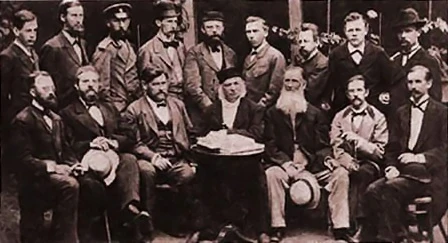
George Ellery Hale
Astrophysicist who discovered magnetic fields in sunspots and built major observatories.

via Wikipedia: George Ellery Hale · see source
George Ellery Hale was an American astrophysicist best known for his discovery of magnetic fields in sunspots. He was a key figure in the planning and construction of several world-leading telescopes: the 40-inch refracting telescope at Yerkes Observatory; the 60-inch Hale and 100-inch Hooker reflecting telescopes, both at Mount Wilson Observatory; and the 200-inch Hale reflecting telescope at Palomar Observatory. He played a key role in the foundation of the International Union for Cooperation in Solar Research and the National Research Council, and in developing the California Institute of Technology into a leading research university.
- born
- June 29, 1868, in Chicago, Illinois
- died
- February 21, 1938, at Las Encinas Sanitarium in Pasadena, California
- field
- Astrophysics
- nationality
- American
- known_for
- Discovery of magnetic fields in sunspots; planning and construction of major tel
Verified Timeline
Lore & Background
George Ellery Hale was born on June 29, 1868, in Chicago, Illinois, to William Ellery Hale and Mary Browne. His father acquired a considerable fortune manufacturing and installing passenger elevators during the reconstruction of Chicago after the Great Chicago Fire of 1871. Encouraged by his parents, Hale built a small shop in their house that became a laboratory, and at age fourteen he built his first telescope. He later attended the Massachusetts Institute of Technology, where he invented the spectroheliograph, and studied at the Harvard College Observatory and in Berlin, though he never finished his PhD. In 1908, using the Zeeman effect with a modified spectroheliograph, he established that sunspots were magnetic, a discovery that led to what is now called Hale's law.
Reader's Guide
Hale's significance lies in his dual role as a pioneering astrophysicist and an extraordinary organizer of scientific institutions. His discovery of magnetic fields in sunspots fundamentally changed the understanding of solar physics and stellar magnetism. Beyond his own research, he was instrumental in creating the infrastructure for modern astronomy: he planned and built the Yerkes, Mount Wilson, and Palomar observatories, each housing the world's largest telescope of its time. He also founded the International Union for Cooperation in Solar Research, helped establish the National Research Council, and shaped the California Institute of Technology into a major research university. His work enabled later discoveries by Harlow Shapley and Edwin Hubble. Despite suffering from neurological and psychological problems that forced his resignation as director of Mount Wilson, his legacy endures through the institutions and instruments he created.
Did You Know?
- Hale invented the spectroheliograph as an undergraduate at MIT, which he later used to discover magnetic fields in sunspots.
- In 1913, Albert Einstein wrote to Hale asking if astronomical observations could test his theory of gravity's effect on light; Hale replied that such observations could only be done during a total solar eclipse.
- Hale suffered from neurological and psychological problems including insomnia, frequent headaches, and depression, which forced him to resign as director of Mount Wilson.
- The often-repeated myth that Hale claimed to have regular visits from an elf who acted as his advisor arose from a misunderstanding by one of his biographers.
- Hale's father acquired a considerable fortune manufacturing and installing passenger elevators during the reconstruction of Chicago after the Great Chicago Fire of 1871.
A Boy with a Microscope and a Dream
George Ellery Hale entered the world in Chicago in 1868, the eldest of three children who survived infancy. His father, William Ellery Hale, had built a substantial fortune manufacturing passenger elevators, a business that flourished during Chicago's reconstruction after the devastating 1871 fire. This prosperity gave young George a privileged environment in which to explore. His parents nurtured his curiosity in complementary ways: his father encouraged his restless, questioning mind, while his mother instilled in him a deep appreciation for poetry and literature. A small microscope became one of his most treasured possessions, and it was this instrument that first drew him toward optics. By fourteen, he had constructed his own telescope, and his father later upgraded the setup with a second-hand Clark refractor mounted on the roof of their Kenwood house. From that vantage point, the young Hale photographed star fields, sketched sunspots, and observed a partial solar eclipse. His intellectual diet extended to the writings of Huggins, Lockyer, and Rutherford, yet he remained a thoroughly ordinary boy who loved fishing, skating, tennis, and the mountain adventures of Jules Verne. Summers spent at his grandmother's home in Madison, Connecticut, were where he first met Evelina Conklin, the woman who would become his wife.
Reading the Sun's Hidden Magnetism
Hale's most celebrated scientific achievement came in 1908, when he applied the Zeeman effect through a modified spectroheliograph to demonstrate conclusively that sunspots are magnetic phenomena. This was not a one-off observation; his subsequent work revealed a striking pattern: sunspot magnetic polarities tended to align along an east-west axis, displayed mirror symmetry across the solar equator, and—most remarkably—the polarity in each hemisphere reversed from one solar cycle to the next. This systematic behavior is now known as the Hale–Nicholson law, or simply Hale's law. Earlier, as an MIT undergraduate, he had invented the spectroheliograph itself, the very instrument that enabled his discovery of solar vortices. Beyond magnetism, Hale devoted a large share of his career to the challenge of imaging the solar corona without waiting for a total eclipse—a problem that ultimately eluded him and was solved later by Bernard Lyot. In 1913, Albert Einstein wrote to Hale asking whether certain observations could test his theory of gravity's effect on light; Hale replied that such measurements were possible only during a total solar eclipse.
The Architect of Giant Eyes
Hale possessed an almost superhuman drive to build ever-larger instruments for peering into the cosmos. His career as an institutional architect spanned four generations of great telescopes. He was instrumental in the planning and construction of the 40-inch refracting telescope at Yerkes Observatory, then moved to the reflecting era with the 60-inch Hale telescope and the 100-inch Hooker telescope, both at Mount Wilson Observatory. The crowning achievement was the 200-inch Hale reflecting telescope at Palomar Observatory, which bore his name. At Mount Wilson, his influence extended far beyond hardware: he recruited and mentored Harlow Shapley and Edwin Hubble, giving them the resources and freedom to make some of the most consequential discoveries of the time. After stepping down as director at Mount Wilson, Hale built the Hale Solar Laboratory in Pasadena, California, where he maintained his office and workshop, continuing his lifelong fascination with the Sun. His vision was not merely to erect glass and steel but to create environments where the next generation of astronomers could push the boundaries of what was known.
Weaving a Web of Science
Beyond his individual discoveries, Hale shaped the infrastructure of modern science with a breadth that few contemporaries matched. He served as editor of the Astrophysical Journal from 1895 onward and coedited Astronomy and Astrophysics in the early 1890s, giving the field a permanent voice in print. He sat on the board of trustees for Science Service, now the Society for Science & the Public, from 1921 to 1923. His international vision led him, as chairman of a National Academy of Sciences committee, to champion the creation of an international body for coordinating solar research. The inaugural meeting of that organization took place at the 1904 St. Louis Exposition, drawing representatives from sixteen national scientific societies—though the Prussian Academy of Sciences notably declined the invitation. He also played a central role in transforming the California Institute of Technology into a leading research university and helped establish the National Research Council. His father's friend, architect Daniel Burnham, had advised him at seventeen to pursue further education at MIT, and that single piece of guidance set in motion a life of building institutions as much as instruments.
Frequently Asked Questions
Who is George Ellery Hale?
He was an American astrophysicist born in Chicago in 1868 who became one of the most influential figures in shaping modern observational astronomy. His career spanned from the late 1800s through the 1930s, during which he transformed both solar physics and the engineering of large telescopes.
What is George Ellery Hale's most important scientific discovery?
Hale is best known for proving that sunspots are regions of intense magnetic activity, a breakthrough that fundamentally reshaped how scientists understand the Sun. This work laid the groundwork for what would later become the field of solar magnetohydrodynamics.
Which major telescopes did George Ellery Hale plan or build?
He drove the design and construction of the 40-inch refractor at Yerkes, the 60-inch and 100-inch reflectors at Mount Wilson, and the 200-inch Hale telescope at Palomar. Each of these instruments was the largest of its kind in the world at the time and dominated astronomical research for decades.
What role did George Ellery Hale play in founding scientific institutions?
He was a driving force behind the creation of the National Research Council and the International Union for Cooperation in Solar Research. He also helped establish the California Institute of Technology as a major center for scientific inquiry.
When and where did George Ellery Hale pass away?
Hale died on February 21, 1938, at the Las Encinas Sanitarium in Pasadena, California. He was 69 years old at the time of his death.
More in Astronomers And Astrophysicists 1-24
Elsewhere in the Astronomers And Astrophysicists universe
Spotted an error? Know more?
This is a living reference — every entry is fact-audited, and reader corrections feed straight into our audit queue. Suggest an edit · See this site's audit record